

[ad_1]
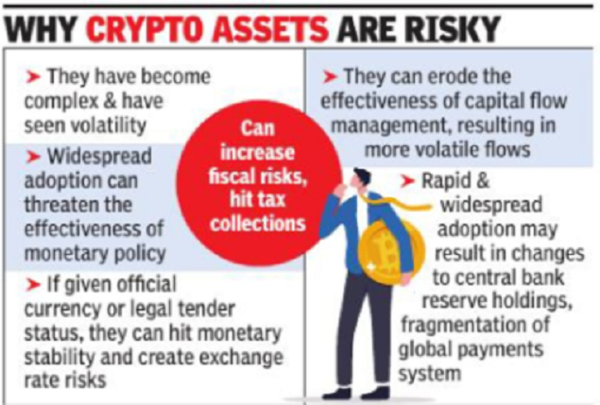
Underlining the need to safeguard monetary sovereignty and stability, the IMF-FSB “synthesis paper” has outright rejected giving crypto official currency or legal tender status and has called upon governments to minimise fiscal and monetary risks. It has, however, supported the use of temporary restrictions to guard an economy against the threat posed by crypto assets.
The 45-page document, which was shared with deputies of the G20 finance track earlier and made public on Thursday, has called for co-ordinated international standards to shield economies from potential risks, while also recommending the use of FATF norms to check money laundering, terror financing and proliferation of weapons of mass destruction.
Apart from macro-economic and monetary policy concerns – which were acknowledged in the paper – India has cautioned over the misuse of crypto assets, which have lost sheen in recent months for terror funding and money laundering. In fact, investigative agencies have come across cases where crypto assets were used to move money illegally out of the country.
For a long time, the government has called for a synchronised approach to regulate crypto assets and maintained that regulation by one country cannot be effective. As a result, during its presidency of G20, India has worked towards evolving a global architecture which can extend to countries outside the group, along with a roadmap to implement it.
Among the first issues that any country will need to work on is clarifying the legal position, either through the application of an existing law or by enacting new ones.
One of the issues that needs to be addressed is to adopt “unambiguous tax treatment” of crypto assets, including those related to income tax and value added tax (GST in India’s case). A key element of the regulation would require governments to collect accurate data so that it can assess the amount of inflows or outflows to guard against excessive capital flow volatility as well as management of fiscal risks.
During times of capital outflows or inflows, crypto assets can be used to circumvent the capital flow management system to move funds in or out of the country, which will also have a bearing on the exchange rate.
[ad_2]
Source link


