

👁️
Post Views: 126,315
[ad_1]
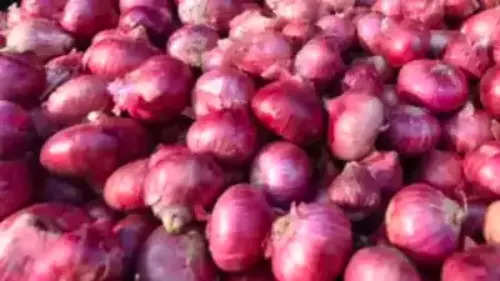
The onion trade sector has appealed to the government to establish a minimum price for calculating export tariffs on onions, aiming to maintain equitable conditions for all stakeholders. This plea comes in the wake of recent bans and limitations on wheat and rice exports, which have adversely impacted business operations, reported ET.
In an attempt to curb the substantial increase in retail onion prices, the central government recently enforced a 40% export duty on onions. However, the official notification did not specify a floor price, which the trading community argues could lead to an unfair advantage for specific ports and stakeholders.
Ajit Shah, President of the Horticulture Produce Exporters’ Association (HPEA), has emphasized the importance of determining a uniform minimum price for calculating export duties across various land and sea ports. Shah conveyed this concern to the government through a letter, stating, “We fear that there may be a disparity in the floor prices being considered for the calculation of export duty on onions across different ports.”
The imposition of bans and restrictions on wheat, rice, and onion exports, as part of the government’s strategy to stabilize domestic food prices, has resulted in revenue losses and accumulation of inventories for businesses. Industry executives have expressed the challenges they face due to these measures.
Executives representing non-basmati rice exporters noted that unsold stocks are accumulating at ports due to the sudden ban on non-basmati rice exports on July 20. The government last week announced “exceptions” to this ban for specific types of non-basmati white rice varieties, including semi-milled, wholly milled, polished, and glazed rice.
These actions follow previous export restrictions in 2022, where India prohibited broken rice exports and imposed a 20% tariff on non-basmati rice exports. “The agri business faced setbacks due to export restrictions on wheat and rice in the April-June quarter,” the country’s largest wheat exporter ITC noted in its earnings call last week. “These restrictions have resulted in lower business opportunities and weighed on segment revenue during the quarter,” it said.
Amidst these challenges, there is anticipation within the industry about the global rice market. While prices have escalated, experts like Akshay Gupta, Business Head of Bulk Exports at KRBL, the foremost basmati rice exporter, anticipate this surge to be short-lived.
Meanwhile, in Nashik, the largest onion-growing region in India, traders protested the export duty on onions by closing markets on Monday. Jayadatta Holkar, Director of Mumbai APMC, explained the discontent among onion farmers, emphasizing that they have faced losses due to subdued prices for an extended period. Many farmers are still awaiting the government’s promised subsidy to compensate for their financial setbacks.
In an attempt to curb the substantial increase in retail onion prices, the central government recently enforced a 40% export duty on onions. However, the official notification did not specify a floor price, which the trading community argues could lead to an unfair advantage for specific ports and stakeholders.
Ajit Shah, President of the Horticulture Produce Exporters’ Association (HPEA), has emphasized the importance of determining a uniform minimum price for calculating export duties across various land and sea ports. Shah conveyed this concern to the government through a letter, stating, “We fear that there may be a disparity in the floor prices being considered for the calculation of export duty on onions across different ports.”
The imposition of bans and restrictions on wheat, rice, and onion exports, as part of the government’s strategy to stabilize domestic food prices, has resulted in revenue losses and accumulation of inventories for businesses. Industry executives have expressed the challenges they face due to these measures.
Executives representing non-basmati rice exporters noted that unsold stocks are accumulating at ports due to the sudden ban on non-basmati rice exports on July 20. The government last week announced “exceptions” to this ban for specific types of non-basmati white rice varieties, including semi-milled, wholly milled, polished, and glazed rice.
These actions follow previous export restrictions in 2022, where India prohibited broken rice exports and imposed a 20% tariff on non-basmati rice exports. “The agri business faced setbacks due to export restrictions on wheat and rice in the April-June quarter,” the country’s largest wheat exporter ITC noted in its earnings call last week. “These restrictions have resulted in lower business opportunities and weighed on segment revenue during the quarter,” it said.
Amidst these challenges, there is anticipation within the industry about the global rice market. While prices have escalated, experts like Akshay Gupta, Business Head of Bulk Exports at KRBL, the foremost basmati rice exporter, anticipate this surge to be short-lived.
Meanwhile, in Nashik, the largest onion-growing region in India, traders protested the export duty on onions by closing markets on Monday. Jayadatta Holkar, Director of Mumbai APMC, explained the discontent among onion farmers, emphasizing that they have faced losses due to subdued prices for an extended period. Many farmers are still awaiting the government’s promised subsidy to compensate for their financial setbacks.
[ad_2]
Source link


