

[ad_1]
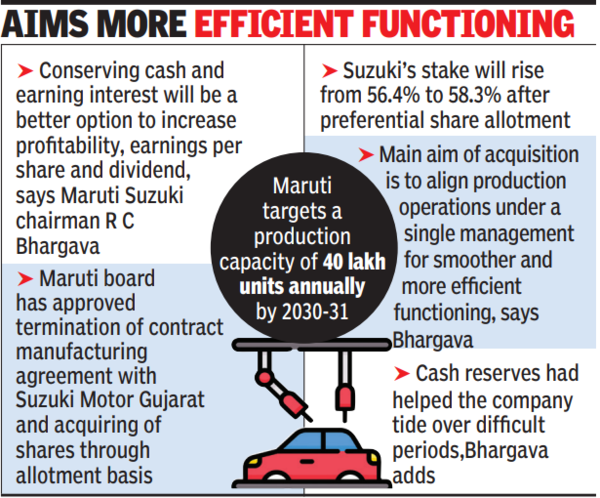
The company on July 31 announced its board’s intentions to take over Suzuki Motor’s plant that has a book value of around Rs 12,755 crore against Rs 18,000 of investments (after depreciation). The board has approved termination of contract manufacturing agreement with Suzuki Motor Gujarat and acquiring the shares through the allotment basis. The preferential share allotment will see Suzuki’s stake go up to 58.3% from 56.4%. “The board decision is subject to all legal and regulatory compliances, including minority shareholders’ approval,” Bhargava said.
“Profit after tax (PAT) of Maruti would be higher in the share-swap option in each year, increasing by over Rs 1,400 crore in 2030-31. The EPS would be higher in the swap option, starting from Rs 7 per share and going up to Rs 20 per share in 2030-31, and the dividend payable, with the same pay-out ratio, would be higher in the swap option. This is primarily because in the swap option, while there is a continued additional earning of interest income, the equity dilution is very low,” Maruti said. The company added that its assessment is based on “hypothetical figures and assumptions” and “are not to be taken as Maruti’s projections of profit”.
The future PAT figures are based on an assumed 12.5% growth each year, the company said, adding that it is considering an interest rate of 7%. The minority shareholders’ approval will be sought at an EGM or through postal ballot, which would also consider the views of the other shareholders.
Bhargava reiterated that the main aim of the acquisition is to align the production operations under a single management for a smoother and more efficient functioning, taking into consideration the company’s future growth prospects where it envisages total production capacity of 40 lakh units annually by 2030-31.
Asked why the company is not using cash to go for the deal as it has huge reserves, Bhargava said Maruti’s shareholders would want higher dividend and share price, that would come through share issuance. He said on its part, Maruti has been making investments for new plants, R&D, and engineering development. He added that cash reserves had helped the company tide over difficult periods such as the 2008 financial crisis, the pandemic, and the semiconductor shortage crisis.
[ad_2]
Source link


