
[ad_1]
It is extremely important to keep a tab on the red flags of a company, the shares of which you are holding in your portfolio. This not only helps to determine the potential risks that could hamper the overall gains at the portfolio level but also alerts investors to weed them out at the right time.
However, most of the time, it becomes extremely difficult to search for such potential problems as it requires one to be well-versed in financial concepts. Investors need to develop a special skillset in accountancy or even forensic audit in some cases.
In my previous webinar (link at the bottom), I explained how such red flags can be spotted like a walk in the park using InvestingPro+.
Let’s take the example of Indian Oil (NS:) Corporation Limited, which is an oil marketing company with a market capitalization of INR 1,27,091 crore. It’s a good company and to me, it seems worth adding to a portfolio, especially for its dividends payouts.
However, before making an investment decision, I would like to see all the red flags in an easy-to-decipher manner. So, let’s check out InvestingPro+ for this.
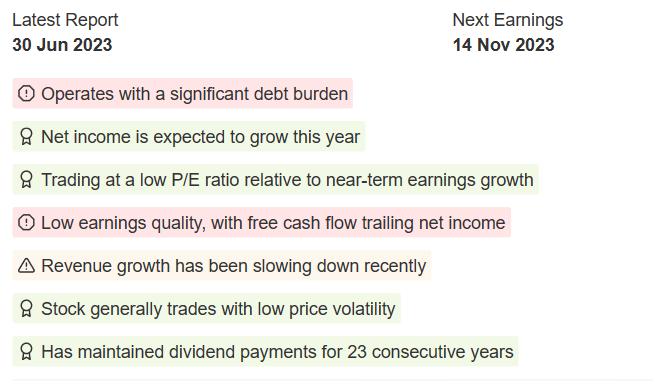
In this image, I can clearly see that analysts are expecting the net income of the company to grow in FY24 (this year). The stock is also trading at a low P/E ratio, making the CMP a good entry point.
For those who like to steer clear of volatility, this tool also analyzes volatility and in the case of IOC, it’s suggesting that it’s a low-volatility counter. I didn’t have to check this parameter separately. And the star characteristic of IOC is its healthy dividend. But without checking the dividend history, InvestingPro+ has highlighted a 23-year streak of consistent dividend payouts.
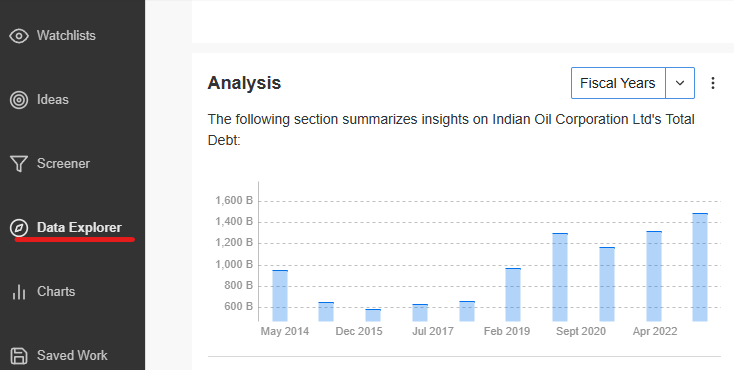
All these were good points about the company but that’s not all. Now comes the imp. part – Red flags. As you can see, the first issue is a high debt burden which I need to check before making an investment decision. So going to Data Explorer > Total debt (image below) I can see the trend in the total debt of IOC, which is currently at INR 1,489 billion. And as the histograms show, it has been consistently increasing over the past few years.
The side notes also raise a concern over free cash flows. No worries, let’s see the trend of free cash flows per share.
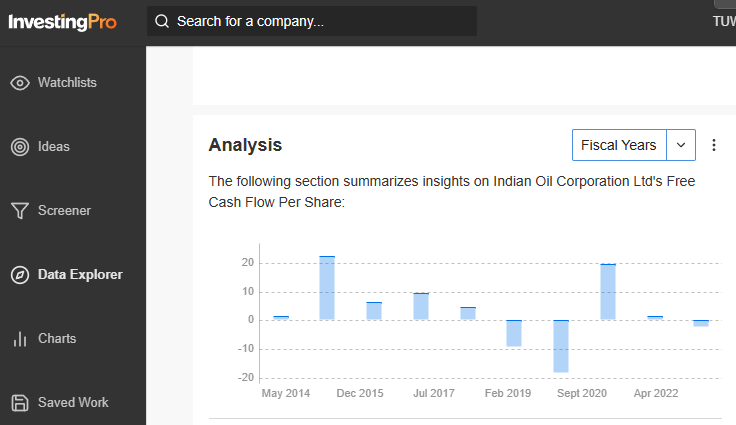
As per the March 2023 quarter, the TTM FCF per share was INR -2.15 which probably should not be too concerning as it is not highly deviated from the average. But investors can give their own weightage to this. You can also check the performance tab (image below) to dig deeper.
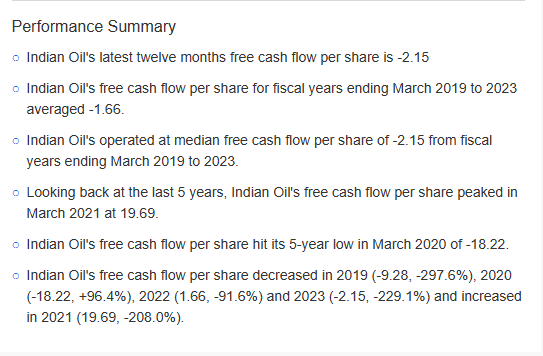
This is how I do a quick health check of the stock I hold in my portfolio and stay informed about all the potential red flags. And in case I find something worth taking action, I make my decision as and when I find the prices right to exit.
Thank you to all who attended my webinar on 27 September 2023. Those of you who missed the session can access the full recording here: https://t.co/V6wF7yhAwl
Remember, the massive offer of a 65% discount on InvestingPro+ via the coupon code PROW478 is only valid till 10 October 2023. Here’s the payment link:InvestingPro
For any assistance reach me out at aayush.k@investing.com or on X (formerly, Twitter) – aayushxkhanna
[ad_2]
Source link


